Looking-glass corruption
The Snow QueenLooking-glass corruption is the power retained by the fragments of the Demon’s mirror after it shatters: goodness and beauty seem diminished, faults loom larger, and a fragment lodged in the heart can make it cold. Its reach extends from distorted appearances to altered judgment and conduct. Kay’s corruption makes that progression visible, while Gerda’s tears reverse it by thawing his heart and removing the splinter from his eye.
The Mirror’s Distorting Power
The corruption begins with a looking-glass made by the Demon, whose enchantment reverses ordinary judgment. Whatever is good or beautiful in its reflection seems to shrink almost to nothing; whatever is worthless or bad appears larger and worse. Lovely landscapes resemble boiled spinach, people look hideous and unrecognizable, and even a single freckle spreads across a face. Good or pious thoughts, too, are misrepresented. The mirror does not merely make a picture ugly: it offers a false measure of the world, making the distorted view seem like a revelation of what things are really like.
The Demon’s pupils carry the mirror everywhere, and people across lands and among different peoples are made to see through it. Their boast that they can now see the world and humanity as they truly are exposes the inversion at the center of the corruption: they mistake the mirror’s distortion for insight. When they try to take it up to heaven to look at the angels, it grows slippery in their hands and falls. Its shattering does not end its power. The glass breaks into millions of fragments, some smaller than a grain of sand, and the pieces scatter through the air into every country.
Fragments in Sight and Heart
A fragment in the eye may lodge there without its bearer knowing. From then on, the person sees through a distorted medium, or sees only the worst side of what is before them. Smallness offers no protection: even the tiniest splinter preserves the power of the intact mirror. Larger pieces extend the same corruption into ordinary surroundings when they are made into windowpanes or spectacles; through them, friends cannot be seen rightly or justly. The effect is therefore not confined to one enchanted object. The mirror’s broken material enters the instruments through which people look at the world.
A fragment in the heart produces a different but related change: the heart becomes cold as a lump of ice. This inward effect makes the corruption more than a problem of misleading appearances. The eye magnifies faults; the heart loses warmth. The Demon laughs at the harm, but the fragments’ dispersal makes the damage persist beyond his immediate presence. The shattered mirror becomes a multitude of small agents of distortion, carried into daily perception and feeling.
Kay’s Corruption
Kay experiences both forms of the damage. While he and Gerda sit with a picture book, he feels something strike his heart and soon afterward notices something in his eye. Although he thinks the eye fragment has gone, it remains, and a grain has lodged in his heart and turned it quickly to ice. His response to the roses marks the change in perception: he sees worm-eaten and crooked flowers, declares them ugly, and kicks their boxes and tears the roses away. Gerda sees nothing in his eye, so the injury is invisible to her even as its consequences become unmistakable.
The alteration spreads into Kay’s relations with other people. He mocks the picture book as fit only for babies, interrupts Grandmother’s stories, and imitates her behind her chair with spectacles. In the street he mimics people’s peculiarities and disagreeable traits. Observers interpret this behavior as evidence of cleverness and genius, but the narrative identifies it as the work of the fragment in his eye and the coldness in his heart. He also teases Gerda, who loves him. The episode connects corrupted sight to corrupted conduct: what Kay notices becomes a license to ridicule, while affection and childlike interests lose their value to him.
The Finland woman later explains that Kay is with the Snow Queen and believes her domain to be the finest place in the world because everything there suits his altered taste. The fragments in his eye and heart must be removed, she says, or he will never be a human being again and the Snow Queen will retain her power over him. Her explanation links Kay’s apparent contentment in the icy palace to the corruption rather than to a free or clear judgment of that place. When the Reindeer asks for strength equal to twelve men for Gerda, the Finland woman refuses the premise that greater force is needed. She says Gerda already has the power she can offer: her own purity and innocence of heart.
Removal and Reversal
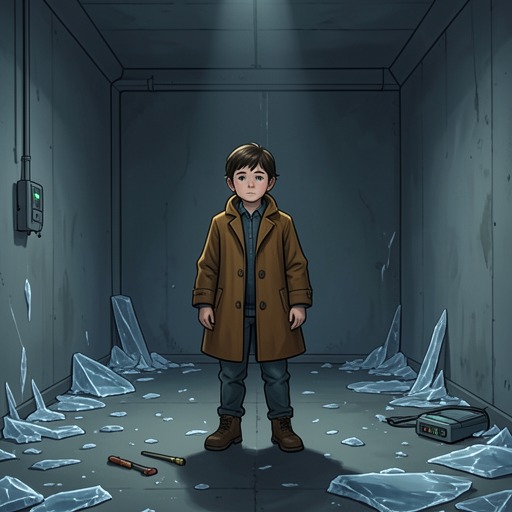
Gerda reaches Kay in the Snow Queen’s empty hall and throws her arms around his neck, but he remains stiff and cold. Her hot tears fall on his breast, penetrate his heart, and thaw the lump of ice; they also wash away the fragment lodged there. She then sings the remembered verse about roses and the Christ-child. Kay bursts into tears, and the splinter swims out of his eye. He recognizes Gerda and asks where she has been and where he has been, registering both his recovered relationship with her and his changed perception of the place around them: it now seems cold, large, and empty.
The recovery is physical as well as emotional. Kay clings to Gerda, and his tears complete what her tears began: the heart’s ice melts, and the eye’s fragment is expelled. The pieces of ice around them dance, then form the letters of the word the Snow Queen had required him to discover before he could be his own master. His freedom is thus tied to the removal of the corruption as well as to the successful completion of her condition. Gerda kisses his cheeks, eyes, hands, and feet; he becomes healthy and cheerful. The Snow Queen may return, but Kay’s certainty of freedom has been written in the ice.
Narrative Significance
The corruption’s movement from whole mirror to scattered fragments gives the story’s central danger a lasting, pervasive form. The original object can be dropped and broken, yet its power survives in pieces small enough to go unnoticed. Its physical fragments explain why distorted perception can seem private or natural to those affected, while their conduct reveals the damage to others. Kay’s injury also turns the mirror’s broad claims about seeing the world into an intimate conflict: Gerda cannot see the splinter in his eye, but she recognizes the change in the boy she loves.
The remedy answers the mirror’s coldness with tears, recognition, and remembered words rather than superior force. The Finland woman’s diagnosis and refusal to augment Gerda’s strength prepare for this resolution: Gerda’s innocence is not a weapon that overpowers the fragments but the condition that allows her to reach Kay and restore their bond. The ending reverses the mirror’s logic. Instead of isolating faults and diminishing goodness, Kay’s tears release the fragments, renew his capacity to recognize Gerda, and make possible their return from the Snow Queen’s palace.